Thursday, February 27, 2014

Learning to Ride: Pedaling and Your First Bike Ride

If you've followed the advice of the second post in this series, you practiced balancing with the pedals off the bike. You've gotten used to sitting on a bike, your sense of balance improved, and you are ready for the next step.

Put the pedals back on your bike, or have your bike shop do it for you. Take your bike to the secluded area you did last time. If you like, lower the seat to a position that allows you to easily put a foot down. (In the long run this isn't ideal for either your knees or your pedaling efficiency, but if it helps you and doesn't give you pain its OK for a few minutes.) Or keep the seat in the place the shop set it at for you. Whatever makes you comfortable and confident.

The purpose of this series is to lay out a simple approach for an adult to learn to ride. I've purposely skipped a lot of stuff a beginner will need to eventually learn - how to fix a flat tire, how to use the gears, riding in traffic, etc - to focus on the actual act of riding a bicycle. You can learn the rest later. For now lets start riding.

Speaking of starting, here I have to explain why I practice differently than I'm going to advise you. The late
bicycle expert Sheldon Brown wrote extensively on the better way to mount a bicycle. Because I am balance-challenged, I have to balance myself and the bike on the toes of one foot before I push off. See the photo to the right. I agree with Brown that this is inefficient, and I recommend you read his article on starting and stopping. Keep in mind that Brown was a purist on many matters, and I don't think that on a bike there is a "right" and "wrong" so much as good and better. I recommend you follow, if possible, Brown's "Correct Basic Starting Technique" described in the linked article. Click over, read it, and then come back. We'll wait.

Regardless of how you start, start. Those pedals are turning. Congratulations, you are now riding a bike. Now get used to it. The reason we came back to the place you were coasting is because you are probably going to be wobbly and uncertain. My first ride was famously so, as I crashed while trying to avoid a mailbox. I didn't realize that we instinctively steer towards what we look at. And my turning was sloppy. You can do better, and these few minutes riding, getting the feel for the bike, are about your doing better.

As I wrote above, I didn't realize instinct is to steer towards something we look at. Don't make the same mistake. While you are riding, try to keep a straight line. Pick something ahead but not in your direct path - a mark in the pavement, a basketball hoop, a mailbox - to look at while keeping a straight line. Do this a few times until you feel comfortable.

As for turns, as a new bike rider you are going to be wobbly and have wide turns. The wobble will go away and the turns will improve as you gain experience, and speed. Practice will help, but the point of the riding today is to get you familiar with how the bike handles. You are getting a feel for riding. And speaking of which if you lowered the seat before, you can raise it up again during this practice riding. Get used to it at its normal position.

By now you've probably gotten sick of riding around the parking lot. Lets go for a longer ride. But not too long. For your first ride I recommend no more than a mile or two. (A normal slow riding speed is about 8 miles per hour, so two miles would be around a quarter hour or so.)  Its OK to do less than that. Its also OK to have your first ride on another day if you like.

When you go for your first ride, I recommend a multi-use path or a quiet street. Remember, your bike is a vehicle, and you should obey traffic rules - don't ride on a sidewalk, ride WITH traffic on the right side of the road, and as far to the right as practicable. I recommend, if possible, riding with a friend, for not only companionship but also in case you have a problem or question.

After your first ride it might become apparent why I suggested you stick with a short distance. You will be sore, and your butt will probably hurt. The soreness comes from using muscles differently than they've been used before. The pain in your butt is getting used to a bike seat. Yes, the internet is full of stories about people who purchased some wonderful bike seat - or, as its often called, a saddle - and rode it pain-free right out of the box. For most people, that isn't true. You might have a sore posterior for a couple of days. While the immediate response is, "I need a new seat", I suggest you stick with the one you have a while. Cyclists often change their saddles in the hope of finding a more comfortable one, but they've also been riding a lot longer than you have. Give it a shot, and see if its more comfortable on the next few rides.
Ditto for any other soreness you may feel. You and your bike will be adjusting to each other for a long time, but at first the muscles will need to adjust to their new movements and position. If you have actual pain while riding, speak with a bike-riding friend, or your bike shop, about making adjustments. But soreness should go away as you get used to riding.

As for your second ride, I suggest waiting a day or two after the first if you feel tired. Give yourself time to recover. Riding too much too soon might exhaust you and give you the idea that cycling, after all, isn't for you. That would be wrong. Riding a bike IS for you, and now you can do it. Welcome to the world on two wheels! How far you go with it, how far the bike takes you, is in your power.


Labels: ,

Learning to Ride: Pedal-free Coasting.

The first post in this series answered common objections an adult might have when told he could learn to ride a bicycle. Now we move on to to the next step, learning to balance.

When I taught myself to ride, I made things hard. My pride, which is both a strength and a failing, prevented me from researching how to learn, and I just got on the bike, and after ten minutes working up the nerve, pushed off and began to pedal. This was the wrong approach. It worked because I was too stubborn and too determined, but since it was December 23 I straddled my bike, the fact that I began to move and stayed upright was a Christmas miracle.

What I should have done, and what I recommend to you, is to use a wrench and carefully remove the pedals. (If you prefer and your bike shop is willing they can take them off for you.) Lower the seat on the bike to the point that when you straddle it your feet barely touch the ground and you are comfortable.

Now, "comfort" is a relative term. Riding a bike isn't a difficult activity, but it is an activity. Even a recumbent bike, the kind that look like a recliner on wheels, is a human powered machines. And the bike itself is going to take getting used to, because your position on your bike isn't like siting on a sofa. So while your bike shouldn't cause pain, you might experience some discomfort at first from the novelty of your posture.

If you've purchased your bike from a bike shop, they've probably already adjusted it to so it "fits" you, or sold you a bike of about the right size. If you didn't purchase your bike from a shop, or had a bike-riding friend adjust it for you, check this simple point: can you reach the brakes and shifters on the bars easily, without straining? Look at the photo to the right. You can see I'm stretching a little too much. You will probably want a little more bend in your elbows. You might be less upright than I am - in my case its due to my bad back. Bike fit is a complicated subject with many differing approaches and opinions, and I don't want to give advise on fitting a bike other than the minimum required to get you riding.

Back to your pedal-less bike. What you've done by removing the pedals is turned your bike into a device for developing your sense of balance. Even relatively fit people can have this ability underdeveloped. And for some people like the very sedentary or the super-obese, balance can be a big challenge. Riding a bike will help develop this sense. And we start here.

Now that you have your bike set up, its time to play. Find a place with a hard surface, and if possible a slight downward slope. You don't want a steep up or down grade for this training. A secluded location is nice if you are uncomfortable having other people see you coasting on your pedal-less bike. For its coasting you are going to do. Straddle the bike, and give a push with one of your feet to set you coasting. Pick up your feet and roll. If you wobble, that's OK. Remember your feet are close enough to the ground you can put a foot down any time you feel like you are going to fall.

As you coast, practice using the brakes. When you brake expect the bike to stop suddenly, like a car does when the brakes are applied quickly. Get used to the feeling of the bike stopping. Again, you have your feet to stop you from falling.

You will discover the bike wants to remain upright when its in motion. And after a few minutes of this you will begin to develop a sense of how to remain upright on the bike. Some people pick up on it right away, and some people will need more time coasting. Keep doing it until you feel you are comfortable. Be prepared to feel tired when you are done, as you will be working small muscles that you probably don't otherwise work.

While you've worked your sense of balance, you've also gotten used to sitting on a bike. You've learned where your brakes are, gotten used to holding the handlebars, felt the seat under you.... you've started the process of teaching your body what riding a bike is like. Regardless of how well you have your bike fitted, its an odd feeling getting into this machine for the first time, and now you've done it without having the additional stress of riding.

As I mentioned above, I didn't know about removing the pedals and just got on and rode. That first ride was a mile and ended with a crash. My second ride basically followed the advice I've listed in this post, except I left the pedals on. I took the bike to a field near my home, lowered the seat, and spent an hour coasting. Since this was the dead of the Pennsylvania winter, the ground was frozen solid and free of snow. Had I known better, this is what I would have done the first time. It might have saved me a hole in my jeans, a skinned knee, and a walk back to my house with the chain off my bike.

In our next post, get ready to ride....


Labels: , ,

Learning to Ride: Overcoming Your Excuses

"I didn't ride a bicycle as a child."

I said this, and I thought I was the only person who didn't. But after I became a bike rider I discovered that many adults don't know how to ride a bike. What I thought of as a universal rite of childhood isn't. And especially in recent years as physical and outside activity became less common for children I'm meeting young adults who have never been on a bike. When I've mentioned they could take up bicycling as an adult, they seem surprised, but also reach for excuses about the difficulty of learning.

This series of posts, "Learning to Ride" is about breaking those excuses and getting it done. In 2005 I didn't know how to ride a bike. I taught myself at the end of 2006. And I rode a century, a ride of one hundred miles in a day, ten months later. I'll never claim I am a model cyclist, but I was determined, and ever since then I've studied how best to teach adults to ride. The material and methods in this series are based on my own experiences teaching myself and other adults, and other reading online and in printed literature. I've used photos of myself to illustrate the text at times. This isn't because I'm a great cyclist, but because I'm not a great cyclist.

Now then, on to the objections....

"Its hard for an adult to learn to ride a bike."

Nah, its only hard for an adult to overcome his objections. The actual learning is easy. Read the rest of these posts and find out.

"I'm too old to ride a bike."

Tell that to my friend Beverly, who is 71 years young. She's actively riding. As for being too old to learn to ride a bike, I'm glad no one told me that. I was 40 when I taught myself. I might have listened to them.

"I'm too fat or too out of shape to ride a bike."

Bicycling is an activity that involves effort. But cycling is easier for the sedentary than many activities - swimming is more physically tiring, for instance, or at least I found it to be. As for being too fat, in most cases that isn't true. I was 275 pounds when I learned to ride. When my weight ballooned after my knee replacement surgery I was over 340 pounds and riding. I know of many obese and super-obese men and women who ride bikes. Admittedly there are special considerations one should keep in mind when you are super-obese and taking on a physical activity, but the general rule is that if you can move, you can ride.

"I have bad knees/back/hearing/hand/foot, so I can't ride a bike."

I had bad knees before I had artificial ones. I also had, and have, a bad back and an impaired sense of
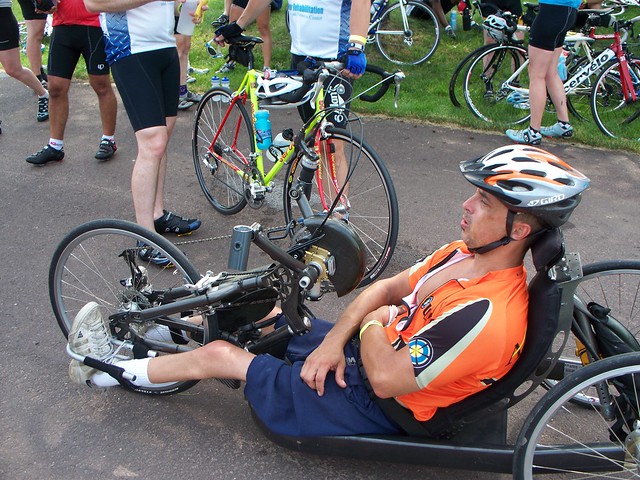
balance. Cycling is easy on the knees, and the rest of my problems were things I worked on with my bike shop. I've known deaf cyclists, people missing a hand, or a foot, or a leg.... in Philadelphia there is a club composed entirely of hand cyclists, using tricycles powered entirely by their arms. The photo to the right is of a hand cyclist riding the French Creek Iron Tour in 2010. He'd been climbing the hills of Chester County, PA, for miles, which explains why he looks tired. The bicycle, and tricycle, are extremely adaptable machines. There will be an adjustment to make the machine fit you.

"I'm going to have to wear those clothes that make me look like something from a comic book."

One of the big excuses against learning to ride as an adult is the idea you need special clothing, and in particular clothing made of Lycra. This stretchy
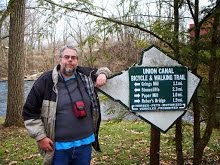
fabric, and the prospect of wearing it, seems to frighten many people. Well, the secret is you don't have to wear it if you don't want to. There are many bike riders, including people who ride long distances, who never wear it. I do wear Lycra, for reasons I'll discuss in another post, but my first bike rides were in jeans, sneakers, and a winter jacket. In the photo at the left I'm wearing shorts, a conventional looking shirt, and running shoes. Remove the helmet and bike and I look like many middle aged men on a summer day. You don't need cycling specific clothing if you don't want it, and there's no need for it now.

"I'm going to have to wear a helmet."

In the above photo I'm wearing a helmet. No law says you have to. I think you should. But you don't have to. I should mention that helmet-wearing is a hot topic among cyclists, and if you want you can spend hours of your time arguing about it. I won't.

"Bike riding is an expensive hobby."

It CAN be. I've seen high end bikes cost more than I paid for a car. It doesn't have to be. I know a man who rides a bike he salvaged from a dumpster. I once owned a bike I paid five dollars for, purchased at a yard sale. My friend Paul started riding on a Huffy he got from Wal-mart. Bikes are in all price points. And while there will be money spent in upkeep, you'll only spend it if you want to keep the hobby.

"I'm going to look silly and people are going to laugh at me."

You won't look silly. People are not going to laugh at you. In the seven years I've been an average bike rider I've not been laughed at once. Even when I wore Lycra into a Target in Easton, MD I wasn't laughed at. I am the poster child for low self-esteem, so trust me when I tell you that no one will think you are silly for learning to ride a bike. They will think this objection is silly, so if you are thinking it, keep it to yourself.

So much for objections. Now, lets learn to ride. Time for the next post.....


Labels: , ,

A Taste For The Woods

This page has moved to a new address.

A Taste For The Woods